Category: Uncategorized
-

2023 Presentations (AERA, ICLS)
Presentations featured in AERA 2023: Lanouette, K. (2023, April). Emotion in Analyzing and Interpreting Data: Implications for Children’s Considerations of Distribution and Variation in Elementary Science. In S. Lee & A. Pierson (Chairs), Affect and Emotion as Productive Sensemaking Resources in STEM Education [Symposium]. Paper presented at the annual meeting of the American Educational Research Association…
-

Research Talk at W&M School of Education
In this talk, Assistant Professor Kathryn Lanouette shared findings from a multi-year research collaboration at an elementary school, where she researched 4th- and 5th-grade students learning about ecological systems and data using participatory GIS maps. Dr. Lanouette also described how children’s connections to the schoolyard – social, emotional, and historical – shaped their understanding of…
-
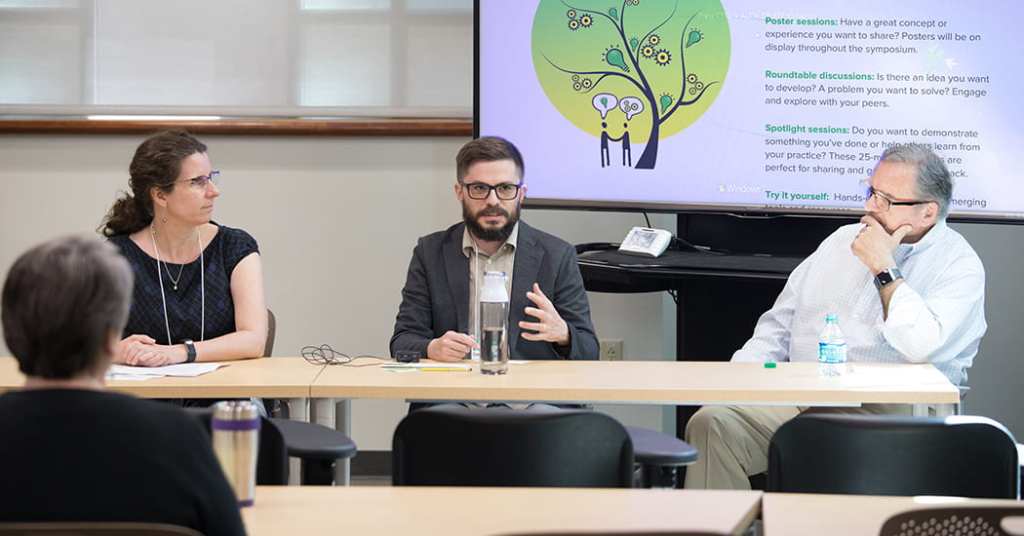
Presentation at Teaching & Learning Symposium
With fellow faculty in the Arts and Sciences, we led a Roundtable sessions titled: MAXQDA in Qualitive Research by Kathryn Lanouette, Monika Gosin, Jennifer Mendez, Meaghan Stiman, Amy Quark, Sasikumar Balasundaram, Brent Kaup, Reya Farber, and Adam Barger. This presentation built from our year-long University Teaching and Learning Project where we collaborated and experimented around different uses of MAXQDA in our teaching and research.
-

Kathryn Lanouette co-edits special issue of the Occasional Paper Series
February 10, 2023, by Stephanie McGuire Bank Street College of Education in New York City has been a leader in progressive education and social justice for over a century. It curates an open-access journal, the Occasional Paper Series, to promote discussion about the meaning of education in democracy and meeting the demands of equity and excellence.…
-

Library Salon #29: Learning within Socio-political Landscapes: (Re)imagining Children’s Geographies
We welcome you to join us for a 90-minute launch event featuring educators and the guest editors of the Bank Street Occasional Paper Series #48, Learning within Socio-political Landscapes: (Re)imagining Children’s Geographies. This issue, which was guest-edited by Kathryn Lanouette, GSE ’06, Assistant Professor at William & Mary’s School of Education, and Katie Headrick Taylor, Associate…
-

Bank Street Releases Occasional Paper Series #48
November 30, 2022 The new Bank Street Occasional Paper Series #48—“Learning Within Socio-Political Landscapes: (Re)imagining Children’s Geographies”—launched today to explore tools, technologies, and practices that can deepen children’s understanding of their immediate environment and how it relates to broader socio-political landscapes. In the Q&A below, guest editors Kathryn Lanouette, GSE ’06, Assistant Professor of Learning Sciences and…
-
2022 Presentations (AERA, ICLS, VAST)
Presentations at AERA 2022 (San Diego): Lanouette, K. & Lee, V. (2022, April). Hyperlocal expertise: Schoolyards as rich and complex contexts for developing children’s data practices. In S. Yoon and C. Miller (Chairs), Data Literacy in Context: Culturally Oriented and Place-Based Learning with Data. Paper presented at the 2022 Annual Meeting of the American Educational Research…
-
Invited Panelist- Deeper Learning 2022
It was wonderful to be a panelist for the Deeper Learning conference in San Diego! Lanouette, K. Invited Panelist, Modernizing Mathematics and Data Science Deeper Learning Conference (March, 2022) Virtual, San Diego, CA. More information on the conference here.
-
Recent chapter out in Routledge edited book on data science
Van Wart, S., Lanouette, K., & Parikh, T.S. (2022). Scripts and counterscripts in community-based data science: Participatory digital mapping and the pursuit of a Third Space. In M. Wilkerson & J. Polman (Eds.), Situating data science: Exploring how relationships to data shape learning (pp. 127-153). Routledge.
-
Recent article out in Science Education
In science education, there has been a sustained focus on supporting the emergence of science practices in K–12 and field-based settings. Recent work has elevated the integral role of emotion in sparking and sustaining such disciplinary practices, deepening the field’s understanding of what is entailed in “doing” science. Yet even as we gain this richer…
 Kathryn Lanouette